• Skip to main content

Swangleys Farm Business

  • Home
  • About
  • Lettings
  • Photos
  • News
  • Contact

Uncategorised

Swangleys Sheep Update

6th January 2026

We have been contacted through the website and by local friends about some Facebook posts on the sheep at Swangleys.  It’s worth reading our News post from a few weeks ago, but I thought it would be helpful to provide additional information on the sheep and this grazing technique.

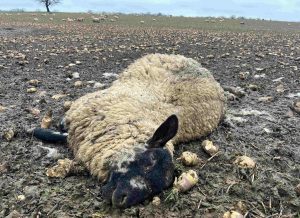
Firstly, please be assured that these sheep, although not owned or managed by Swangleys, are looked after by an attentive and professional shepherd who we know has their wellbeing in mind, checks them every day and takes action where needed.

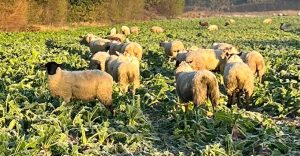
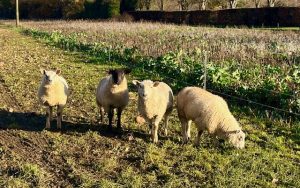
It is worth mentioning again why these sheep are at the farm – as I think some people may have misunderstood this style of grazing.  These sheep are “Mob grazing” a crop of stubble turnips under an environmental initiative in order that their droppings fertilise the soil and therefore reduce the farm’s need to apply artificial fertilisers. Mob grazing looks very different to the sheep grazing over grass that you might be more familiar with.  In grass grazing, sheep densities are low in order that a field’s grass supply is self sustaining. However, in mob grazing, large numbers of sheep are grazed on a relatively small area that is initially high in a food supply and then they are moved to a neighbouring fresh area once they have grazed the feedstock down sufficiently.  This maximises the environmental benefits of the technique, without impacting sheep welfare.  Importantly, at no time are the sheep short on feed – they are simply moved to fresh feed at the right time.  In the case of the Swangleys sheep, that move was scheduled to be today or tomorrow and so by now they may well be in their new well-stocked home right next to the previous field strip.  In a few weeks they will have consumed these new turnips and will move one more strip closer to Knebworth. This will continue around the farm.


Some people have asked about water supply and about sheep being outdoors in this weather.  It is indeed cold at the moment but, across Britain, sheep and obviously all wild animals are out in the elements – this is entirely normal.  Sheep in particular, unlike cattle/horses/deer, benefit from a thick fleece and which is deeply saturated with lanolin – a natural waterproofer.  They also have ample insulating fat reserves. They are hardy animals. Here in the southeast of England our temperatures , despite being cold, are mild compared to those routinely handled by the Welsh and Yorkshire mountain sheep that make up a lot of the British lamb you will find in the supermarket. In terms of water, sheep simply do not need water except when on a dry feed such as hay or in the height of summer.  I think it’s worth saying that, at home, I personally have kept a very small hobby flock of sheep for years – small enough that each sheep has a name, that I know each individual sheep by sight and they know me, I know each of their unique personalities individually and I care for them attentively.  Those sheep – essentially pets – are similarly also out in this same weather and have no water at this time.


Several people have noticed lame sheep – that is, sheep with a limp.  Lameness is a recurring theme with sheep and, in reality, any substantial well-kept flock will at any point in time have some lame sheep.  Each of the sheep hosted at Swangleys had their feet trimmed (the main cause of lameness) on arrival and was treated as necessary. It takes lameness a while to subside and so most of them are already on the road to recovery.  Some, where the shepherd has greater concerns, are routinely removed from the flock for closer care elsewhere.


In summary, please understand that these sheep are well tended by the shepherd and the whole objective of mob grazing is for them to graze a small area down and then be moved to a fresh area.  The most publicly obvious part of a stubble turnip field as seen from afar is the green foliage, which is very quickly grazed away leaving an apparently empty field……….but actually it is the largely un-noticed turnips themselves, tucked away on or under the soil , which are the main source of calories.


We would be very grateful if someone could post a link to this article into Facebook.


Thanks – and thankyou in particular to all those local people with some farming knowledge who have helpfully posted on Facebook many of the same explanations about sheep and this grazing style that I have given above.  We really do appreciate you having stepped in to provide that information.


Filed Under: Uncategorised

Sheep at Swangleys Farm

2nd December 2025

A new “first” for us……. sheep have arrived at Swangleys !


The sheep – 500 so far – are the key part of our latest environmental initiative.  We harvested our wheat this summer and we need the soil’s fertility improving for the summer 2026 harvest.  For many decades, we and most other farms have relied on artificial fertilisers, but last year we successfully trialled the use of compost made from garden waste as an organic and low carbon alternative.  This winter – on some of our fields that need it most – we are going to trial sheep droppings.

Immediately after summer 2025’s harvest, we planted “stubble turnips” – quite different from the turnips you find in the shops.  The turnips usefully gather up nutrients and so stop the winter weather leaching them out of the soil, plus their roots also help to break up soil structure to improve drainage.  Most importantly for us, sheep love them.  The sheep will now be rotation grazed around the fields of the Watton Road/Old Lane part of the farm and will leave behind droppings which are rich in the nutrients that the soil needs.  We will then plough the droppings in and plant cereal crops in the spring …………which will benefit from that natural fertiliser.

The sheep are not ours – instead the arrangement is a simple exchange with their owner :   our turnips for their sheep’s droppings.  Right now (early December), all the sheep are in the triangular field opposite the crematorium, but local residents will see them move from field to field over the next few months.

Filed Under: Uncategorised

Swangleys’ Autumn Sunflowers

24th October 2025

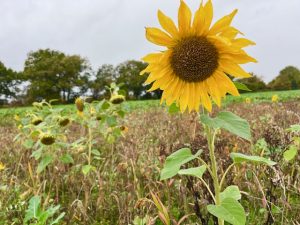
Thanks for the feedback on the sunflower strip alongside the Watton Road opposite the crematorium…… we like them too.

More importantly, the birds like them too.

This sunflower strip is an initiative we began about 3 years ago to provide additional biodiversity and, most importantly, late season food for non-migratory birds like finches (especially), blackbirds, robins and a variety of resident species. It’s been a success and so, each year, we have replanted hundreds of sunflowers.

Sunflowers are high in fat, have thin shells and so are easily accessible for birds and they keep their seeds high and dry for an extended period when other food sources are getting thin.

We also think they look attractive, which is a view we know some local people share.

Filed Under: Uncategorised

Field Fire At Swangleys

29th July 2025

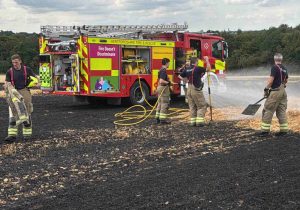
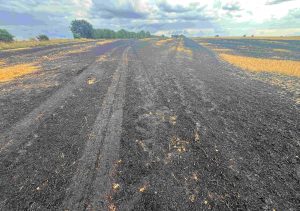
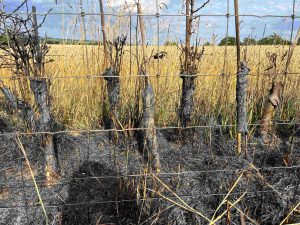
Yesterday, trespassing youths set fire to one of our fields, burning 5 acres and destroying 70 metres of hedging.


The fire brigade and we rushed to Swangleys after an emergency callout to a field on fire yesterday afternoon.  Only through the quick response of Herts Fire & Rescue and through a stroke of sheer luck was our neighbouring farmer’s field of wheat – ready for harvest – not also destroyed.

Our direct experience and that of other local farms is that dry weather and school holidays bring field fires, set by youths trespassing where there is no public right of way.  These fires can have a devastating effect on farms financially, can threaten neighbouring properties and always tie up considerable Herts Fire & Rescue resources which are not then available for saving lives elsewhere.

In addition, this particular fire destroyed 70 metres of hedging we planted around 3 years ago as part of our drive for increasing biodiversity on the farm.  Our farm does not need hedges – we have no livestock to contain – and instead we plant hedges entirely for the wildlife that they bring.  That hard work and money spent on this stretch of hedge is now lost and we will need to start again if we are to replace the lost hedge.

For our neighbours this could have been a catastrophe.  We have sent our thanks to Herts Fire & Rescue for their help and would like to say another thankyou to anyone who phoned in the emergency on 999.  Thankyou for that – your prompt action prevented this turning into something even more damaging..


Filed Under: Uncategorised

Environmental Initiatives At Swangleys

18th April 2025


Some of the local community have asked about the enormous mound of “soil” we have been building up on Swangleys Lane next to Baines Spring – the small wood near Baines Lane.

This mound forms an important part of Swangleys’ move towards more sustainable farming practises.  We already carry out numerous environmental initiatives – many local people will be familiar with the km’s of hedging we have planted, the dozens of trees, the bird seed borders to some fields etc but possibly less aware of other initiatives such as skylark plots. Most people will not be aware that we have already moved from habitual full ploughing to what is known as “min till” where – in order to preserve the soil microbiome and structure – ploughing is largely replaced with a less invasive cultivation.


This spring we are introducing a very significant programme – the start of a move away from total reliance on artificial fertiliser.  Crop-growing land needs fertiliser, but the normal agricultural source is artificial fertiliser made from gas (which is an oil industry product) and mined mineral rocks and therefore carries a high carbon footprint and so, in the long term, is unsustainable. It is not viable at this time for Swangleys to entirely move away from artificial fertiliser, but we are taking a very significant step this year.


The mound of “soil” on Swangleys Lane is entirely comprised of natural compost which has been made out of the contents of people’s brown bins.  After collection, your brown bin garden waste is sorted, cleaned, chopped and then naturally composted over the course of a number of months.  By the end of that process, compost can be spread on fields to not only replace artificial fertilisers and therefore dramatically reduce our carbon footprint but also increases the organic matter in the soils and encourages the vital microfauna to flourish.


This type of compost is not without its issues for us and we will also need to alternate it with other sources of natural fertiliser in order to provide the soil with what it needs, but it is a big step for us and we will be monitoring the results closely.


So, to answer the question that we have been asked, the pile of material on Swangleys Lane is approximately 1,200 tonnes of a total of 2,200 tonnes of natural matter that we will be bringing to Swangleys this spring and integrating into the soil.


Filed Under: Uncategorised

  • Go to page 1
  • Go to page 2
  • Go to page 3
  • Go to page 4
  • Go to Next Page »
Swangleys Farm Business